
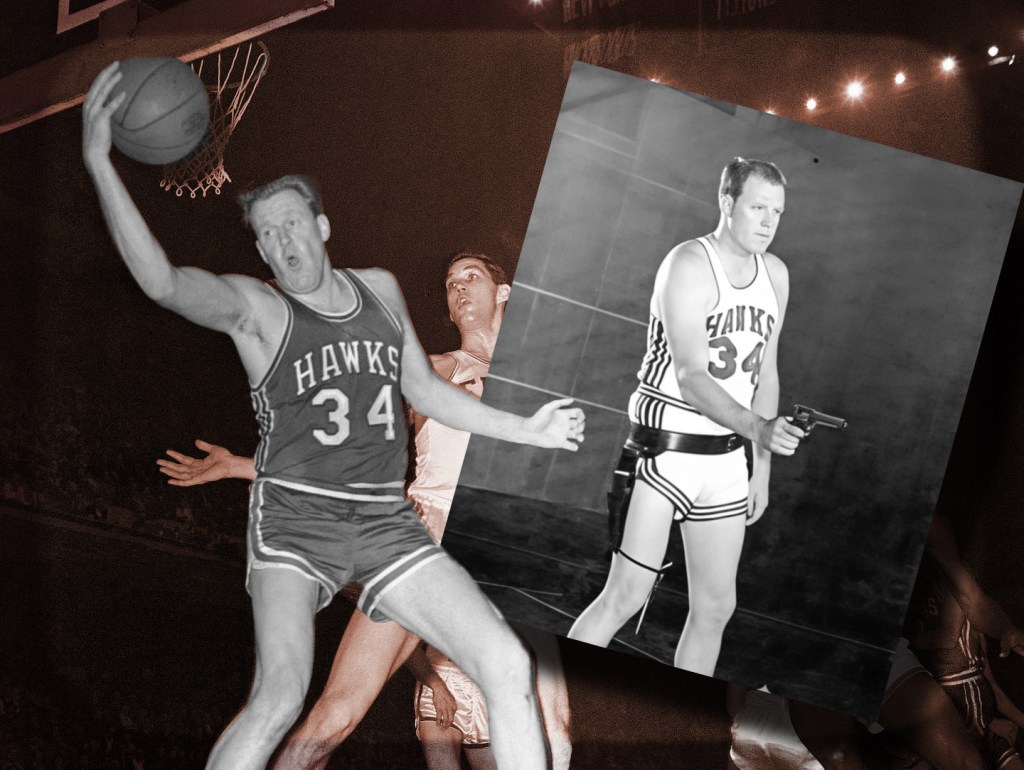
Clyde Lovellette was a basketball legend. To this day the only player to ever lead the NCAA in scoring and win the championship the same year, a feat followed by an Olympic Gold Medal, 4 NBA-All Star selections, 3 NBA Championships, and a induction into the Basketball Hall of Fame. But for every accolade, there’s a darker story: tales of vicious cheap shots, racist behavior, and threats on and off the court. But perhaps the most damning of them all? He just might’ve been the man who caused the death of Wilt Chamberlain.
Clyde was born in the small town of Petersburg Indiana in 1929. By the time he was a senior in High School, he was 6’9 and 240 pounds and was being heavily recruited by colleges. Clyde decided to take his talents to the University of Kansas where he shined. A 2x All-American, 1952 NCAA Champion and MVP, and the Helms College Player of the Year. He was a shoo-in for the 1952 Olympic Basketball Team where he led the team in scoring and took home the Gold. In the 1952 NBA Draft, he was drafted by the Minneapolis Lakers and started his NBA career the following season in 1953.
Clyde quickly became known for his physical, dirty style of play. NBA players who had the displeasure of facing him had this to say in Terry Pluto’s “Tall Tales: The Glory Years of the NBA“:
Tom Meschery – “Clyde Lovellette was the single dirtiest player in NBA history. He was downright mean. He seldom hit you with a fist; usually it was an elbow, a hip or a knee to a very vulnerable spot.”
Wayne Embry – “I hated playing Clyde. He’d elbow you in the Adam’s apple, hit you in the face after you took a shot. If you ran past him, he threw his knee out. He was just a dirty player.”
Along with his dirty style of play, Clyde’s career was marred by accusations of racism, which festered in his time with the St. Louis Hawks. Lovellette was a leading voice in the blackballing of Black rookie Cleo Hill. Coach Paul Seymour, who is believed to have been fired for defending Hill, is quoted as saying “I wouldn’t dream of treating a dog the way Pettit, Lovellette, and Hagan treated Cleo.”
NBA Veteran Tom Meschery echoes the sentiment about the Hawks’ racism, presenting a story regarding his friend Fred LaCour on his blog – “Fred was biracial and dated white women. St. Louis was the least racially tolerant city in the NBA. The three white stars of the Hawks, Bob Pettit, Cliff Hagan, and Clyde Lovellette did not approve of Fred dating white women. They saw to it that he was cut from the team, even though, at the time Fred was released, he had been playing at a very high level.”
On top of this, Clyde had a dangerous obsession with guns, as recalled by former NBA players:
Dolph Schayes told Syracuse.com in 2010: “One night in Lubbock Texas where Clyde and his St. Louis Hawks had played an exhibition game, he paid a visit to the hotel room of Willie Smith, who’d served as a referee in the contest. And when the unsuspecting Smith answered the door, Lovellette pulled two pistols from the holster he was wearing and fired them. ‘Bang. Bang’ and Smith reached for his gut. But they were blanks, they weren’t real bullets, but they made a lot of noise and almost scared Willie to death.”
Bob Ferry in “Tall Tales: The Glory Years of the NBA” shared this story: “I was a rookie and I roomed with Clyde. He was wearing his six-guns everywhere and talking about his new career as a Western star. I was taking a nap, and I heard a clicking noise. There was Clyde, standing in front of a mirror, wearing nothing but a cowboy hat, his guns and holster strapped to his bare legs. Naked, he was practicing his quick draw in the mirror. There was a knock at the door. Clyde had ordered room service and he answered the door still pretty much naked. The room service kid saw Clyde, saw the guns and saw he wasn’t wearing anything else. The kid threw his hands over his head and started to shake. He probably figured Clyde was going to shoot him. Clyde just laughed.”
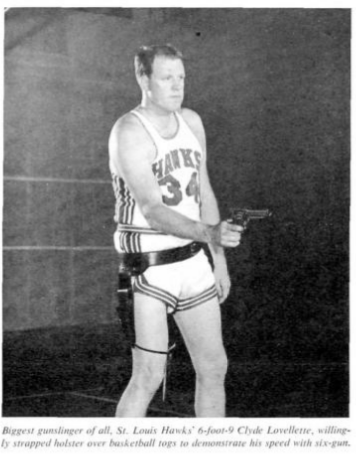
Marty Blake, former Hawks manager, in “Tall Tales: The Glory Years of the NBA“: “Everyone knew that Clyde carried guns around, and Clyde had the kind of personality that made people keep their distance.”
But perhaps the most damning stain on Clyde Lovellette’s career is the belief that one of his dirty cheap-shots may have led to the untimely death of the NBA titan Wilt Chamberlain.
Chicago Tribune reported in 1998 that during Wilt’s rookie season in 1959, “fellow Kansas alum Clyde Lovellette, notorious as the NBA’s dirtiest player, flung his fist back into Wilt’s jaw as they ran up the floor one night, causing a severe cut, later an infection. Cal Ramsay, a Lovellette teammate, had warned Wilt before the game that Clyde was going to ‘get’ him.”
Former NBA Center Joe Ruklick told it like this to SLAM Magazine in 2011:
Joe Ruklick – “I would spend the year warming the bench as Wilt’s backup center, and it was from that vantage point that I saw him take a catastrophic blow to his jaw during a game against the Hawks in St. Louis. The shot thrust his front teeth upward into his lower facial bones and started a bloodstream infection that was to plague him for the rest of his life. Wilt spent more time in the hospital than was reported and many people who knew him best said that it was related to that bloodstream infection. In 2005, Seymour Goldberg, Wilt’s lawyer, told me his health problems resulted from ruined teeth and ultimately from the debilitating effects of a heart sac infection.”
Wilt’s sister, Barbara Lewis, told ESPN in 1999 that “only weeks before he died, Wilt had undergone dental surgery to remove teeth knocked aside during his basketball career. He dropped about 50 pounds in the last month. He told her it was the worst pain he had ever experienced and, she said, it was the first time she had heard him complain about pain.”
The two eventually crossed paths again in the twilight of Clyde’s career, during the 1964 Finals. While Lovellette walked away with another ring, Wilt had the satisfaction of getting his revenge. Tom Meschery told The Japan Times in 2017:
Tom Meschery – “Clyde threw one too many elbows at Wilt, and Wilt knocked him out with one punch. And the punch traveled no more than one foot, maybe at most. It was just a jab, but the fiercest jab I ever saw.”


 The Hooper Holler
Leave a comment